Posted on November 26, 2026
Finding the right office space in Hong Kong is not simply a matter of choosing the lowest rent or the most impressive address. A freelancer who works independently several days a week has very different needs from a five-person team handling confidential client projects, regular meetings and shared equipment.
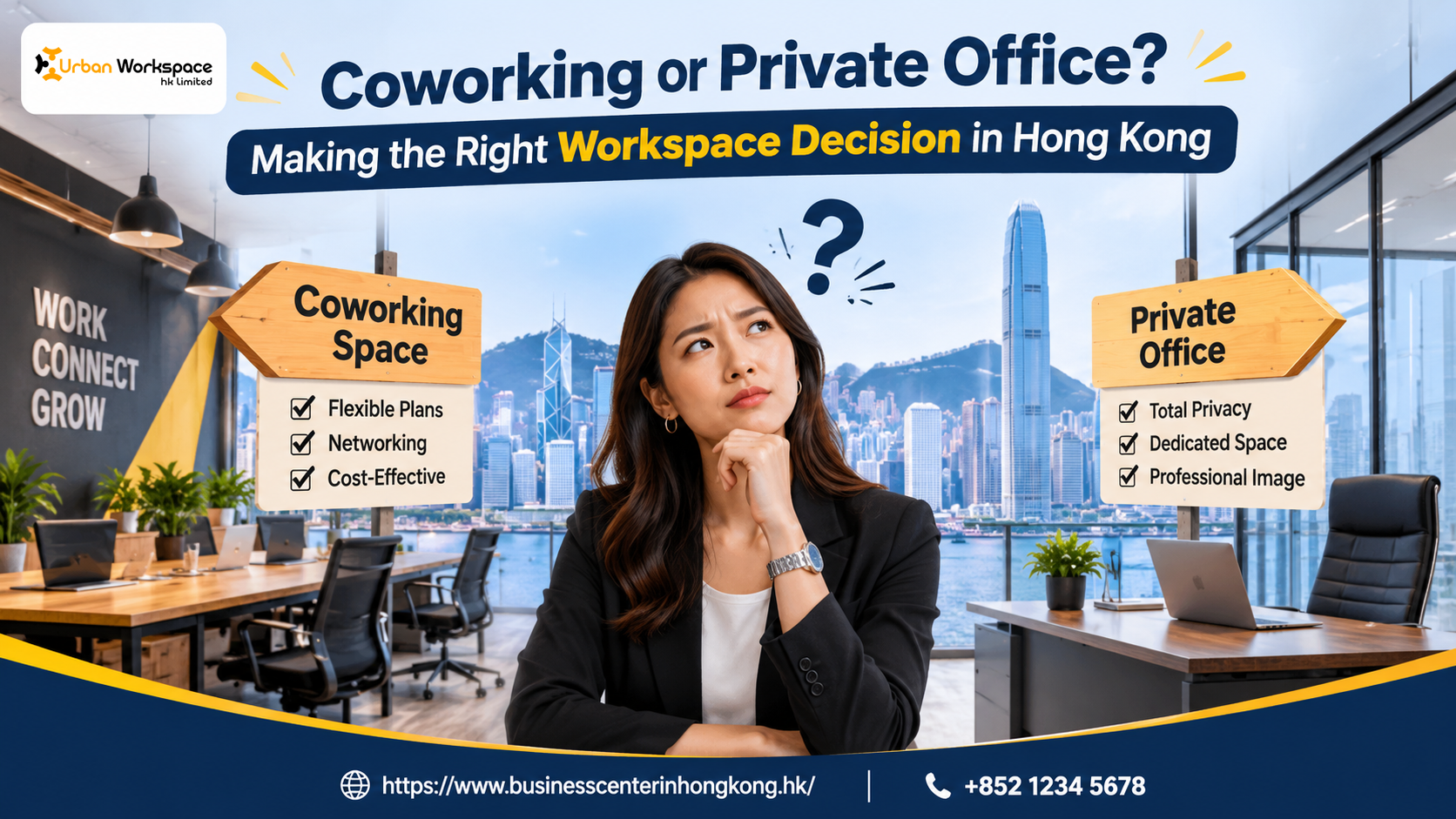
That is why the choice between a coworking space in Hong Kong and a private office in Hong Kong deserves a closer look. Coworking offers shared facilities and flexible access, while a private office gives a team a dedicated environment. Both can be useful, but the better option depends on how your business operates—not just how many people appear on the company organisation chart.
This article takes a practical approach to the decision. Instead of treating coworking as only a starter option or a private office as an automatic upgrade, it examines working patterns, costs, privacy needs and operational details that should guide your choice.
Before comparing workspace packages, map out how the space will be used during a normal week. A company may have six employees but only two people attending the office on most days. Another may have three employees who need to work together in person every day. Headcount alone does not tell you how much space you need.
Write down the answers before visiting locations. This gives you a consistent basis for comparing a shared desk, a dedicated desk, a private studio and a larger serviced office.
A coworking space is a shared working environment where individuals from different businesses use common facilities. Depending on the membership, a provider may offer hot desks, dedicated workstations, part-time access, full-time access, meeting-room hours, internet and shared amenities.
For independent professionals and small businesses, coworking can provide a professional place to work without taking on the responsibilities of leasing and managing a conventional office. It can also create opportunities to meet people from other industries and become part of a wider business community.
Urban Workspace HK's coworking options include part-time and full-time workstation memberships, day access and a private-studio option. The published membership features vary, so confirm current availability, access terms and inclusions directly with the provider before choosing a plan.
A private office gives a company or team a dedicated space that is not shared as an open workstation with unrelated members. In a serviced-office environment, the workspace is typically furnished and supported by shared building or business-centre facilities. The exact package may include internet, reception, IT support, meeting rooms or other services.
The main difference is control over the work environment. Team members can use the same dedicated space, leave approved work materials in place and hold conversations with less exposure to the surrounding shared area. A private office may also make it easier to establish a consistent team routine.
A private office does not necessarily mean taking on a traditional long-term lease. A serviced office in Hong Kong can offer furnished facilities and a service-based arrangement. Review the actual contract, however: office size, access, services, term and fees differ from one provider and package to another.
Use this comparison as a starting point. The details depend on the provider, membership level and office agreement.
| Decision Factor | Coworking Space | Private Office / Serviced Office |
|---|---|---|
| Workspace | Shared environment with hot desks or dedicated desks | Dedicated room or enclosed team workspace |
| Privacy | Limited in open shared areas; private rooms may be bookable | Greater control over who enters the team's workspace |
| Team seating | Depends on available desks and membership | More predictable seating for the assigned team |
| Flexibility | Often suitable for variable attendance and part-time use | Can offer flexible terms, but usually involves a defined office allocation |
| Client meetings | May rely on bookable shared meeting rooms | Can offer a dedicated base and shared meeting facilities |
| Storage | May be limited or subject to lockers and membership rules | Usually offers more control over storage within the private space |
| Team identity | Shared atmosphere and community environment | More consistent setting for internal team routines and branding |
| Cost structure | Membership or desk-based fee | Office or workstation service fee, potentially with bundled facilities |
| Best suited to | Individuals, remote workers and flexible small teams | Teams needing privacy, consistent attendance and dedicated space |
A low monthly membership fee may look attractive, but the real cost depends on how often you use the space and what you need to add. Similarly, a private office may appear more expensive until you compare it with the cost of several coworking memberships, frequent meeting-room bookings and external facilities.
Calculate the cost per actual office-use day or per regularly attending team member. If a coworking member uses a desk only six days a month, a full-time plan may not be economical. If four employees attend every weekday and frequently need to work together, several separate desk memberships may not provide the same value as a dedicated office.
Privacy is one of the most important differences between open coworking and a private office. It matters particularly for businesses that handle client records, financial information, legal documents, intellectual property or internal commercial discussions.
Shared workspaces can be effective for routine laptop-based work, individual tasks, networking and informal collaboration. Members should still use headphones or book an appropriate room for confidential calls, and avoid leaving sensitive documents or devices unattended.
A private office can make it easier to control access, conduct confidential conversations and establish a quieter working environment. It does not automatically guarantee data security: businesses should still manage device access, screen privacy, document storage, visitor procedures and network security.
Hong Kong businesses often work with clients, suppliers and partners across different districts. A workspace that looks impressive online may not be the most practical if employees struggle to reach it or clients find it inconvenient.
Consider the journey from major transport links, the locations of your customers, nearby food and business facilities, parking needs and the frequency of face-to-face meetings. If your team travels regularly, a convenient location can save time every week.
Urban Workspace HK lists workspace locations including Harbour Centre, Tower 2, Focal Industrial Centre, Block A and Peninsula Square for its serviced-office enquiries. Its coworking page identifies its coworking centre at Harbour Centre. Check the exact unit, available workspace type and current access arrangements when arranging a visit.
Workspace packages can differ significantly in the services bundled with the desk or office. A coworking membership may provide a limited number of meeting-room hours, while a serviced office may include reception or IT assistance. Other providers may offer these facilities as optional extras.
Urban Workspace HK describes meeting rooms with presentation and video-conferencing facilities, along with on-site administrative and IT support. Its serviced-office information also refers to high-speed internet, front-desk assistance and technical support. Confirm which facilities apply to the particular location and package you are considering.
Some businesses do not fit neatly into the choice between an open coworking desk and a larger private office. A private studio or compact enclosed workspace can provide more separation than a shared desk while avoiding the need to take a larger office than the team requires.
This option may suit a founder who needs a consistent base, a two-person operation that handles frequent calls, or a small team that wants to work together without using an open shared area. The exact layout and privacy level vary, so inspect the space rather than relying on the package name.
A workspace decision and a company-address decision are related, but they are not identical. Renting a coworking desk does not automatically mean that the membership includes a registered office, a business registration address, mail handling or permission to display the company's name at the premises.
If you need an address service for your Hong Kong company, ask the provider exactly what is included and which address uses are permitted. Confirm whether the arrangement covers statutory mail, ordinary business correspondence, mail notifications, collection or forwarding. Do not assume a desk membership automatically provides these services.
Likewise, having a registered office or virtual business address does not mean you have a private place for employees to work or clients to visit. Select the workspace based on actual operations, and arrange address services separately where required. For legal or registration questions, verify requirements with the relevant Hong Kong authorities or a qualified company-secretarial professional.
| Business Type | Likely Starting Point | What to Prioritise |
|---|---|---|
| Freelancer or consultant | Part-time coworking or day access | Convenient access, reliable internet, occasional meeting rooms |
| Remote employee | Hot desk or dedicated desk | Quiet work areas, access schedule, connectivity |
| Solo founder | Part-time or full-time coworking | Predictable access, professional setting, manageable monthly cost |
| Two-to-four-person team | Dedicated desks or private studio | Seats together, collaboration, privacy for calls |
| Client-facing consultancy | Private office or coworking with meeting-room access | Visitor experience, confidentiality, meeting availability |
| Growing operational team | Private serviced office | Consistent seating, storage, IT and administrative support |
These are starting points rather than fixed rules. A consultant may need a private office for confidential work, while a larger company with hybrid attendance may use coworking memberships effectively. Match the arrangement to the work itself.
Once you have shortlisted a coworking space or private office, review the written terms carefully. A tour can show you the atmosphere, but only the agreement explains what you are entitled to use and what happens if your requirements change.
The right workspace should support your current work pattern while leaving room for change. A founder who needs occasional access may prefer a part-time coworking membership. A professional who works on site every weekday may value a full-time workstation. A team that needs greater privacy and a consistent base may find a private studio or serviced office more practical.
Urban Workspace HK Limited, featured on Business Centre in Hong Kong, offers coworking memberships, serviced offices, virtual office services and bookable meeting rooms. Its listed workspace locations include Harbour Centre, Tower 2, Focal Industrial Centre, Block A and Peninsula Square for serviced-office enquiries. Availability and the services attached to each location should be confirmed directly.
Before making a decision, share your expected team size, preferred start date, number of office days, meeting-room needs and budget. Ask the team to explain the options that fit those requirements, including any included services and additional charges.
Coworking often has a lower starting commitment because members share facilities and pay for a desk or access plan. A private office may cost more but provides dedicated space and greater control. Compare the full cost, including meeting rooms, extra desks, storage and services, against how much space your team actually uses.
Coworking generally provides shared workspace with membership-based desk access. A serviced office usually provides a furnished, dedicated office or workstation with facilities and support services bundled into a service arrangement. Exact inclusions vary by provider.
Coworking can suit freelancers, consultants, remote workers, solo founders and small teams that value flexible access, shared facilities and a professional place to work without leasing a full private office.
A private office may be better for teams that need confidential conversations, regular collaboration, secure storage, predictable seating, frequent client meetings or greater control over their work environment.
Yes. Some coworking providers offer multiple desks, team memberships or private studios. Confirm that enough workstations are available together and check access, meeting-room and storage arrangements before signing up.
A hot desk is a shared workstation used when available, while a dedicated desk is assigned to a particular member. Membership terms determine access hours, storage and whether the same desk is guaranteed.
Do not assume that a coworking membership automatically includes a registered office or business registration address. Confirm that the provider expressly offers the required address service and that the arrangement meets applicable requirements.
Some serviced-office packages include reception, meeting-room access, internet and IT or administrative support, while others charge separately. Ask for a written list of inclusions, limits and additional fees for the specific office.
Many flexible workspace providers offer options to change workspace as a business develops, subject to availability, pricing and contract terms. Ask about upgrade procedures, notice periods and whether the move affects mail or address services.
Check the total fees, deposit, contract duration, renewal and termination terms, access hours, number of desks, meeting-room entitlements, internet, privacy, mail handling, visitor policies and any extra charges.
Not always. A private studio may be a compact enclosed workspace within a coworking or flexible office environment. A private office can vary in size and may be designed for a larger team. Ask about layout, privacy, access and included facilities rather than relying on the label.
Some memberships may include a business address or mailbox, but this is not universal. Confirm the exact service and whether it is suitable for the intended registration or correspondence purpose. A desk membership alone should not be treated as proof that address services are included.
There is no universal winner in the coworking vs private office decision. Coworking can offer an adaptable and cost-conscious base for individuals and teams with flexible attendance. A private office can provide greater privacy, consistent seating and a dedicated environment for businesses that work together regularly or handle sensitive tasks.
Focus on your real attendance pattern, privacy requirements, client meetings, storage needs and total monthly cost. Then compare the membership or office agreement line by line. The best flexible workspace in Hong Kong is the one that supports your business today without creating unnecessary cost or limiting your next stage of growth.
Contact Urban Workspace HK Limited to discuss coworking memberships, private studio options, serviced offices and meeting-room facilities. Share your team size, expected start date and workspace requirements to identify a suitable option.
Website: https://www.businesscenterinhongkong.hk/
Phone: +852-6553-7375
Email: urbanworkspacehk@outlook.com
Disclaimer: This article is for general information only. Workspace features, pricing, access hours, availability and contract terms may change and vary by location or membership. Confirm all inclusions and permitted address uses directly with the provider before making a commitment. This article does not constitute legal, company-registration or professional advice.







Trusted by entrepreneurs, startups, SMEs, and international companies for Hong Kong company formation, virtual office solutions, registered business address, company secretary services, and ongoing business support.

Business Center in Hong Kong made our Hong Kong company registration process simple and stress-free. Their consultants handled everything professionally, from documentation to incorporation. The communication was excellent, and our company was established faster than expected.

We selected their Virtual Office in Hong Kong package and couldn't be happier. The prestigious business address, professional mail handling, and responsive customer support have helped us build credibility with our international clients.

Their team provided outstanding assistance with company incorporation, company secretary services, and annual compliance. Every step was transparent, professional, and completed on time. Highly recommended for overseas entrepreneurs.

We were looking for reliable business setup services in Hong Kong, and this team exceeded our expectations. Their knowledge of local regulations and quick responses made the entire process smooth and efficient.

We've been using their registered office address and company secretary services for over two years. Everything is managed professionally, allowing us to focus entirely on growing our international business.

Excellent service from start to finish. From Hong Kong business registration to ongoing compliance support, every interaction has been professional, transparent, and reliable. We confidently recommend Business Center in Hong Kong.