Posted on November 16, 2026
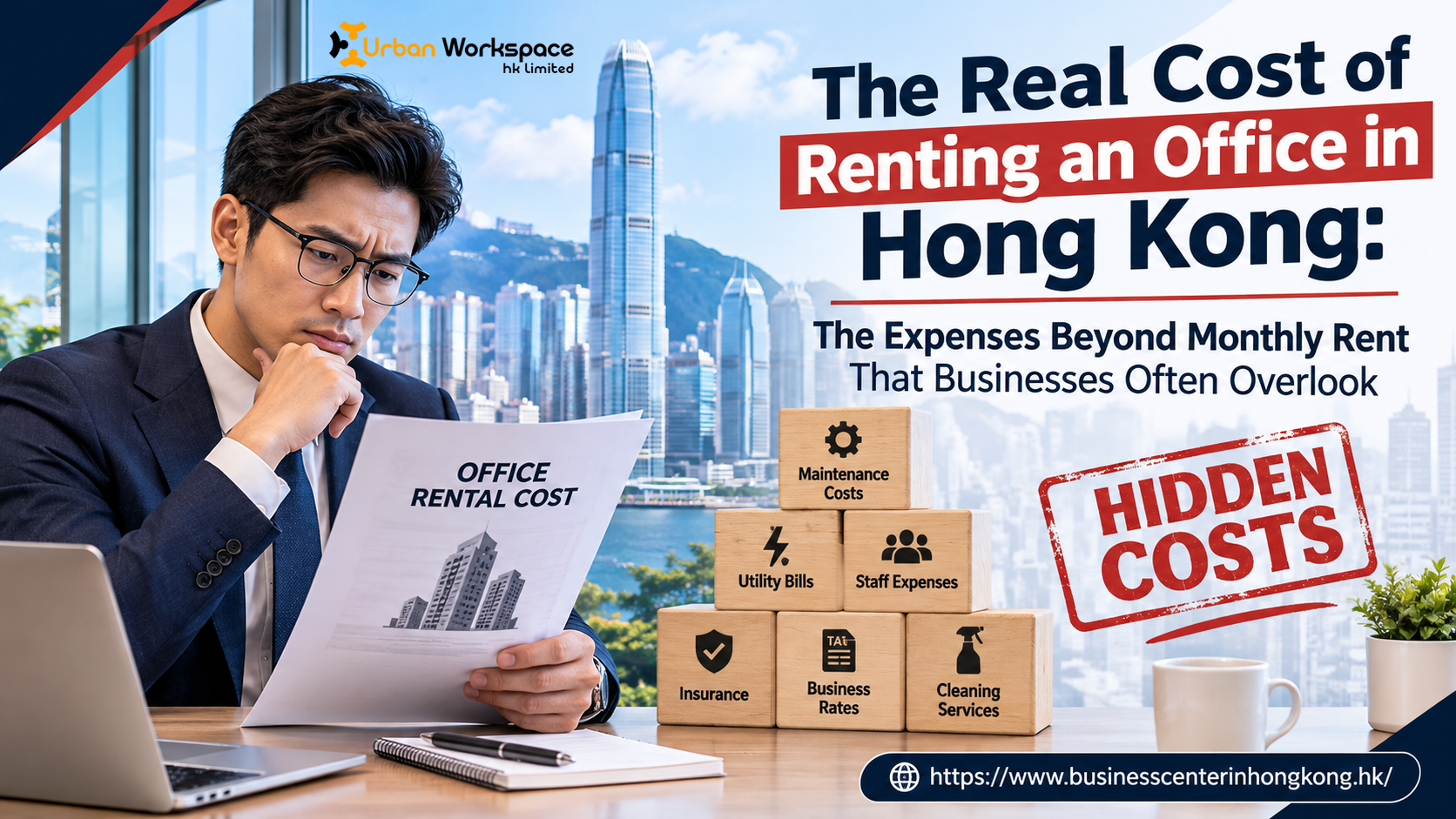
Finding an Office Space for Rent in Hong Kong often starts with one simple question: “How much is the monthly rent?” But the advertised rental figure rarely tells the complete financial story. A traditional office can involve deposits, agency fees, stamp duty, management charges, utilities, renovation, furniture, IT infrastructure and costs that appear when the lease ends.
For a startup, a small professional firm or an overseas company entering the Hong Kong market, choosing the wrong workspace can tie up cash that would be better spent on hiring, marketing, inventory or customer acquisition. The goal is not simply to find the cheapest office. It is to understand the Total Cost of Occupancy and pay for facilities your team will genuinely use.
This guide breaks down the main cost categories, explains what to ask before signing, and shows when a Serviced Office Hong Kong solution, a Virtual Office Hong Kong package or a flexible combination may be more practical than a conventional lease.
Commercial property listings usually place the base rent front and centre. That figure is important, but it may exclude expenses that are billed separately or paid only once during setup. Two offices with similar headline rents can therefore have very different total costs.
For a fair comparison, separate the budget into three groups:
These costs affect cash flow in different ways. A refundable deposit is not the same as a non-refundable setup expense, but it still ties up working capital. A one-time fit-out cost may not appear in the monthly rent, yet it changes the effective cost of occupying the office during the lease.
Commercial landlords commonly require a security deposit before the tenant takes possession. The amount is set by the landlord and the terms negotiated in the tenancy agreement. It may be calculated by reference to rent and other payable charges. The tenant may also need to pay rent in advance.
When comparing Hong Kong Office Rental options, ask:
Do not treat a refundable deposit as a routine monthly expense. Record it separately in your cash-flow plan because the money may remain unavailable for the full lease period.
If a commercial property agent helps source or negotiate the premises, an agency commission may be payable. The amount and the party responsible should be confirmed in writing before committing. Include this fee in the initial office setup budget rather than discovering it after agreeing the headline rent.
A commercial tenancy agreement can contain important provisions about permitted use, repairs, alterations, insurance, renewal, rent review, subletting, early termination and reinstatement. Legal review may involve a separate professional fee, but it can help identify obligations that would otherwise become expensive later.
Hong Kong tenancy agreements are generally subject to stamp duty. The rate depends on the lease term and rent. The Inland Revenue Department's published guidance sets out the following general rates:
| Lease term | General stamp duty rate |
|---|---|
| Term not exceeding 1 year | 0.25% of the total rent payable over the tenancy term |
| Term exceeding 1 year but not exceeding 3 years | 0.5% of yearly or average yearly rent |
| Term exceeding 3 years | 1% of yearly or average yearly rent |
| Term not defined or uncertain | 0.25% of yearly or average yearly rent |
The tenancy agreement should generally be stamped within 30 days after execution. All parties executing the agreement may be liable for the duty. The agreement itself should specify how the parties intend to handle payment, but that arrangement does not remove statutory obligations. Always check the latest IRD stamping guidance for the applicable calculation and procedure.
Many commercial buildings charge management or service fees separately from base rent. Depending on the building and agreement, these may contribute to common-area maintenance, security, cleaning, building operations and shared facilities. Confirm the current rate, how it is calculated, whether it can change and whether it is included in the advertised rental figure.
Check the tenancy agreement to understand whether rates and government rent, where applicable, are payable by the landlord or passed on to the tenant. Do not assume these are included in the monthly rent. Ask for the latest relevant figures and how future adjustments will be handled.
Utility expenses depend on office size, operating hours, equipment, occupancy and the building's billing arrangements. A small team using laptops may have a very different consumption profile from a business operating servers, specialist equipment or extended shifts.
Some buildings provide central air-conditioning during standard building hours and charge separately for use outside those periods. If employees regularly work late, host evening meetings or operate across time zones, check the building's After-Hours Air-Conditioning Charges and access rules before signing.
A vacant or bare office may look attractive in a property listing, but it can require significant investment before it becomes usable. The actual requirement depends on the condition of the premises, the landlord's provisions and the type of business.
Possible work includes partitions, flooring, lighting, painting, ceiling work, power points, cabling, pantry facilities and meeting-room construction. Some changes may require landlord approval, building management approval or qualified contractors. Ask who is responsible for approvals and whether the work must comply with building rules.
Budget for desks, ergonomic chairs, storage, reception furniture, meeting tables and other equipment. A business that hires rapidly may also need spare workstations or flexible layouts. Buying furniture can create a large initial expense and a later removal or resale task.
Reliable connectivity is essential for most modern businesses. Setup may involve broadband installation, routers, switches, Wi-Fi access points, structured cabling, firewall equipment, video-conferencing hardware, printers and user devices. Ask whether internet installation, network support and any dedicated connection are included in the premises or service package.
Depending on the work, you may need access cards, visitor controls, CCTV arrangements, secure storage, backup power or additional network safeguards. These are not identical for every business, so specify the operational requirements before choosing the office.
A physical office is not just a property expense. It can create recurring work for employees or outsourced providers.
If clients, suppliers or candidates visit regularly, someone needs to welcome them, manage calls and coordinate arrivals. Hiring a receptionist creates salary, recruitment, training and leave-cover costs. Outsourced reception or a serviced-office reception arrangement may be an alternative, depending on the level of support required.
Consider cleaning schedules, waste removal, pantry supplies, washroom arrangements, repairs and replacement of consumables. Confirm which services are covered by the building and which must be arranged directly by the tenant.
Review the insurance requirements in the tenancy agreement and consider the business's own risks, equipment and activities. The appropriate cover varies by business and should be confirmed with a qualified insurance adviser.
Separate bills, service contracts, maintenance requests, access cards and supplier renewals take time to manage. For a small company, this work may be handled by a founder or employee whose time could otherwise be spent on revenue-generating activities.
When a lease ends, the tenant may be required to return the premises to an agreed condition. The exact obligation depends on the tenancy agreement, the condition at handover and any approved alterations.
Reinstatement may involve removing partitions, signage, cabling, furniture or tenant-installed fixtures and repairing affected surfaces. Before signing, clarify what must be removed, what can remain and whether the landlord can require restoration to the original condition.
Relocation can involve movers, packing, temporary storage, new internet installation, equipment testing and staff time. If the business cannot operate normally during the move, lost productivity may be another indirect cost.
Check whether the lease includes a break clause, how much notice is required, whether there are penalties for early termination and how rent changes on renewal. A low initial rent may be less attractive if the contract is difficult to exit or scale down.
Instead of comparing rental advertisements alone, calculate the full expected cost over the period you realistically expect to occupy the space.
For a monthly comparison, estimate the recurring expenses and spread relevant one-time non-refundable setup costs over the expected occupancy period. Keep refundable deposits separate as cash tied up rather than treating them as an expense.
| Cost category | Questions to include in your budget | When it occurs |
|---|---|---|
| Base rent | What is the rent, payment frequency and review mechanism? | Recurring |
| Deposit and advance rent | How much cash is required before occupation and when is it refundable? | Upfront |
| Agency and legal fees | Who pays, how much and what work is covered? | Usually upfront |
| Stamp duty | What rate applies to the lease term and who will arrange stamping? | At lease execution |
| Management fees and rates | Are they included, separately billed or adjustable? | Recurring |
| Utilities and air-conditioning | Are there meters, usage limits or after-hours charges? | Recurring / usage-based |
| Fit-out and furniture | What must be installed, approved, maintained or removed? | Setup and exit |
| Internet and IT | Are installation, support, security and upgrades included? | Setup and recurring |
| Reception and cleaning | Who handles visitors, calls, cleaning and consumables? | Recurring |
| Reinstatement and moving | What is required when the lease ends or the team relocates? | Exit |
A traditional lease can give a business greater control over its premises, layout and branding. It can also place more responsibility on the tenant to arrange fit-out, furniture, utilities, connectivity, reception and day-to-day operations.
A Serviced Office in Hong Kong is a different model. The workspace provider typically supplies a furnished office and selected facilities or support services under a service agreement. The package may reduce the need for a tenant to coordinate multiple suppliers, but businesses should always check the exact inclusions and any usage limits.
| Consideration | Traditional office lease | Serviced office |
|---|---|---|
| Initial setup | Tenant may need to arrange fit-out, furniture and connectivity. | Furnished workspace and existing infrastructure may be available. |
| Lease or service term | Often negotiated for a fixed tenancy period. | May offer more flexible service terms; confirm minimum commitment. |
| Utilities and internet | May be separately arranged or billed. | May be bundled; check allowances, speed and additional charges. |
| Reception and support | Tenant arranges its own staff or suppliers. | Reception or administrative support may be available. |
| Meeting facilities | Tenant provides and maintains its own meeting room. | Shared or bookable meeting rooms may be available. |
| Scaling the workspace | Changes may require renegotiation or relocation. | Some providers offer options to move to a larger or smaller workspace. |
| Cost predictability | Depends on separate contracts and variable charges. | Can be easier to forecast if inclusions and limits are clearly documented. |
Urban Workspace HK Limited describes its Serviced Offices in Hong Kong as furnished workspaces with flexible lease options, high-speed internet, reception support and IT assistance. Its listed locations include Harbour Centre, Tower 2; Focal Industrial Centre, Block A; and Peninsula Square. Confirm current availability, package terms and the precise facilities included directly with the provider.
Not every business needs a permanent desk or private office every day. A company with a remote team, overseas founders or occasional in-person meetings may need a professional address and communication support more than it needs a full-time physical workspace.
A Virtual Office in Hong Kong can provide selected services such as:
Urban Workspace offers different Virtual Office Packages with address, communication and additional service options. Review what each package covers and confirm whether the address is appropriate for your intended business registration, licensing or correspondence needs. A virtual-office service should not be assumed to satisfy every statutory, licensing or operational requirement.
Some teams need a regular place to work but do not require a dedicated private office. Others work remotely and only need a professional room for client presentations, interviews or team sessions.
Co-Working Space in Hong Kong can suit freelancers, consultants, startups and distributed teams that value shared infrastructure and flexible usage. Before choosing a membership, compare access hours, desk availability, internet, printing, lockers, meeting-room credits, guest policies and any limits on use.
Explore Co-Working Spaces in Hong Kong to understand the available workspace options.
If a company only hosts occasional client meetings, interviews or presentations, Meeting Room Rental in Hong Kong may be more economical than paying for dedicated meeting space throughout the year. Compare the booking rate with the frequency of use, room capacity, display equipment, video-conferencing facilities, catering, additional seating and cancellation rules.
Urban Workspace lists bookable Meeting Rooms in Hong Kong with facilities such as display equipment, whiteboards and video conferencing. Confirm current room specifications, availability and booking charges before making a reservation.
| Your business situation | Workspace model to consider | Why it may fit |
|---|---|---|
| Small team working together every weekday | Private serviced office or traditional office | Provides a consistent base; compare total cost and included support. |
| Overseas founder with no local daily team | Virtual office, with meeting-room access when needed | May provide an address and communication services without a full-time office. |
| Freelancer or consultant needing occasional desk access | Co-working space | Shared facilities can avoid the commitment of a private office. |
| Remote team meeting clients periodically | Virtual office plus bookable meeting rooms | Separates address and communication needs from occasional physical meetings. |
| Growing startup with uncertain headcount | Flexible serviced office or co-working space | May make it easier to adjust workspace as team size changes. |
| Business with specialist fit-out or strict operational needs | Traditional office or a specifically configured serviced office | Allows the business to assess technical, security and layout requirements in detail. |
Whether you are comparing an Affordable Office Space in Hong Kong, a private office or a flexible workspace package, ask for written answers to these questions:
Urban Workspace HK Limited offers several workspace formats through Business Center in Hong Kong. Rather than assuming every company needs a conventional office lease, businesses can assess the type of space and support that matches their working pattern.
The business centre lists locations including Harbour Centre, Tower 2, Focal Industrial Centre, Block A and Peninsula Square. Ask the team to confirm which location, workspace type and facilities are currently available for your requirements.
Compare workspace options before committing to a long lease. Whether you need a furnished private office, a virtual business address, a co-working desk or a meeting room, Business Center in Hong Kong can help you explore the available arrangements.
Visit Business Center in Hong Kong or call +852-6553-7375 to discuss your workspace requirements.
In addition to base rent, review the security deposit, agency commission, stamp duty, management fees, rates and government rent where applicable, utilities, air-conditioning, internet, fit-out, furniture, cleaning, insurance, repairs and reinstatement obligations.
Usually not. A traditional office lease may involve one-off setup costs and recurring charges that are not included in the headline rent. Ask for an itemised schedule of all payments and check the tenancy agreement.
Stamp duty on a tenancy agreement depends on the lease term and rent. General rates are 0.25% for a term not exceeding one year, 0.5% of yearly or average yearly rent for a term exceeding one year but not exceeding three years, and 1% for a term exceeding three years. Check the official Inland Revenue Department guidance for the current rules and calculation.
A traditional lease usually requires the tenant to arrange and pay for more of the premises, setup and ongoing operations directly. A serviced office generally bundles a furnished workspace with selected facilities and support under a service arrangement. Inclusions, deposits, terms and extra charges vary by provider.
A virtual office may suit a business that needs a professional business address and selected mail or telephone handling services but does not need a full-time physical workspace. Check the package scope and whether the address is suitable for the specific registration or licensing purpose.
Yes. Businesses that work remotely or meet clients occasionally may use bookable meeting rooms rather than maintaining a dedicated meeting space. Compare hourly or session charges with the cost of reserving permanent office area.
Confirm the total fee, deposit, minimum term, renewal and termination rules, included internet and utilities, meeting-room allowance, printing, call handling, visitor arrangements, after-hours access, cleaning, storage and any move-out or add-on charges.
It can be less expensive for an individual or small team that does not need a dedicated room every day. The best option depends on how often desks are used, how many people need access, privacy requirements and any additional charges for meeting rooms or services.
No. Some packages include selected utilities and internet, while others may set usage limits or charge separately for upgrades and additional services. Ask for a written list of inclusions and exclusions.
Choosing an Office Space for Rent in Hong Kong is a financial and operational decision. The headline rent is only one part of the commitment. Deposits, stamp duty, management fees, utilities, fit-out, IT, reception, maintenance and reinstatement can all influence the true cost of occupying a workspace.
Before signing, estimate the total cost over the period you expect to use the office, distinguish refundable deposits from actual expenses, and check exactly which services are included. A traditional lease may suit a business that needs long-term control and a customised environment. A Serviced Office, Virtual Office, Co-Working Space or bookable Meeting Room may be more appropriate when flexibility and lower setup commitments matter more.
The best workspace is not necessarily the one with the lowest advertised rent. It is the one that supports your business operations, fits your budget and avoids paying for space and services you do not need.
Disclaimer: This article is for general information only and is not legal, tax, property, financial or professional advice. Lease terms, stamp duty, building charges and service inclusions can vary. Confirm all costs in writing with the landlord, agent or workspace provider, and consult an appropriate professional before signing a tenancy agreement. Prices and package details may change; contact the provider for current quotations and availability.







Trusted by entrepreneurs, startups, SMEs, and international companies for Hong Kong company formation, virtual office solutions, registered business address, company secretary services, and ongoing business support.

Business Center in Hong Kong made our Hong Kong company registration process simple and stress-free. Their consultants handled everything professionally, from documentation to incorporation. The communication was excellent, and our company was established faster than expected.

We selected their Virtual Office in Hong Kong package and couldn't be happier. The prestigious business address, professional mail handling, and responsive customer support have helped us build credibility with our international clients.

Their team provided outstanding assistance with company incorporation, company secretary services, and annual compliance. Every step was transparent, professional, and completed on time. Highly recommended for overseas entrepreneurs.

We were looking for reliable business setup services in Hong Kong, and this team exceeded our expectations. Their knowledge of local regulations and quick responses made the entire process smooth and efficient.

We've been using their registered office address and company secretary services for over two years. Everything is managed professionally, allowing us to focus entirely on growing our international business.

Excellent service from start to finish. From Hong Kong business registration to ongoing compliance support, every interaction has been professional, transparent, and reliable. We confidently recommend Business Center in Hong Kong.