Posted on November 04, 2026
A business does not always operate from the same office, with the same team size or under the same working arrangements. As companies grow, their workspace requirements naturally evolve. A startup may begin with a small shared desk, an overseas entrepreneur may initially need only a professional business address, and an established company may eventually require a larger private office for its expanding team.
But what happens when the office arrangement needs to change before the business is ready to change everything else?
An office relocation, lease expiry, team expansion, temporary renovation or change in operating model can create unexpected challenges. Employees still need to work, clients still expect professional communication, meetings must continue, and important business correspondence must reach the right people.
This is where a Workspace Continuity Plan becomes valuable.
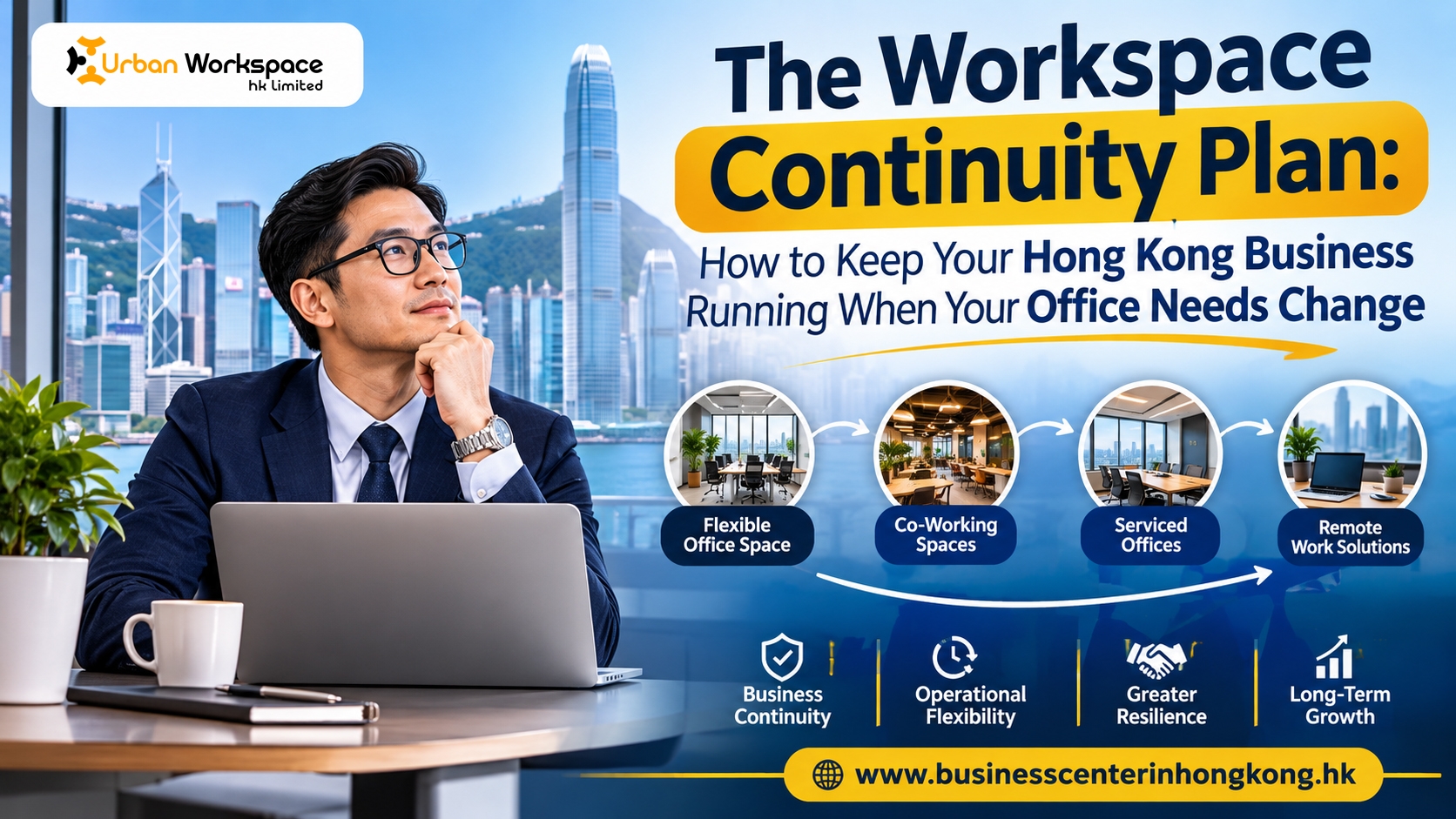
For companies operating in Hong Kong, having access to Flexible Office Hong Kong solutions, Serviced Office Hong Kong facilities, Virtual Office Hong Kong services and professional meeting spaces can make workspace transitions easier to organise.
The objective is not simply to find another office. It is to maintain the systems, communication and professional environment that allow the business to continue functioning while its physical workspace changes.
Whether you are managing a startup, expanding an international business or relocating an established Hong Kong company, the right workspace strategy can help reduce disruption and support future growth.
Workspace continuity refers to a company's ability to maintain its essential working arrangements when its office, team size or operational requirements change.
It is closely connected to the wider idea of business continuity. However, the focus here is on the physical and administrative environment that supports daily business activities.
A workspace continuity strategy considers several important elements:
For example, a company moving from a traditional office to a serviced office may need to reorganise its furniture, IT equipment, address records and employee working arrangements. However, it does not necessarily need to interrupt its client meetings or daily administrative activities.
Similarly, a business that temporarily reduces its physical office requirements may continue using a Virtual Office Hong Kong service for business correspondence and book a professional meeting room whenever an in-person discussion is necessary.
The important principle is simple: the workspace may change, but the business should remain organised.
Hong Kong has a diverse business environment that includes international companies, financial services firms, trading businesses, consultants, technology startups and independent professionals.
Their workspace requirements are not always fixed. Different stages of business development can create very different office needs.
A company that begins with two founders may eventually hire a larger team. The original workspace may no longer provide enough desks, meeting facilities or privacy.
In such situations, moving to a Private Office Hong Kong arrangement or a larger Serviced Office Hong Kong facility may be more practical.
The challenge is to expand the workspace without creating unnecessary disruption to the existing team.
Some businesses move from a traditional office-based model to a hybrid working arrangement. Employees may work remotely on certain days and visit the office for meetings or collaboration.
A company with this operating model may not need a large permanent office. Instead, it may benefit from Flexible Workspace Hong Kong solutions, coworking facilities and bookable meeting rooms.
A lease may expire, a landlord may change the terms of an agreement, or a company may decide to move to another business district.
Relocation often involves more than transporting desks and computers. Businesses must consider employee access, customer communication, official correspondence, internet connectivity and address updates.
A company may require temporary workspace during renovation, office refurbishment, project implementation or an unexpected change in its premises.
A Temporary Office Hong Kong arrangement or Short Term Office Rental Hong Kong solution may provide a practical alternative while the company prepares its long-term workspace.
Overseas companies entering Hong Kong may not immediately require a full-time office with a large employee team.
They may initially need a professional address, administrative support and access to meeting facilities when visiting the city.
A combination of Virtual Office Hong Kong and meeting room services may suit certain early-stage business requirements, subject to the company's statutory and operational needs.
Office relocation is often treated as a property or logistics project. In reality, it affects several interconnected parts of a business.
A company may successfully move its equipment and furniture but still experience problems if communication systems, records or customer arrangements are not updated.
Employees may lose access to their regular desks, equipment or meeting facilities during the transition.
Without temporary arrangements, even a short relocation period can affect productivity.
Important letters, invoices, contracts and official notices may continue arriving at the previous address.
If mail forwarding and collection arrangements are not planned properly, important correspondence may be delayed or overlooked.
Customers, suppliers and business partners may continue visiting or sending documents to the old office.
Companies should communicate address changes clearly and update the relevant contact information across their business channels.
A business may have a temporary workspace but no suitable environment for client meetings, interviews or presentations.
Access to Meeting Rooms Hong Kong facilities can help maintain a professional experience while the regular office is unavailable.
An office move may involve different address records, depending on the company's circumstances.
For example, a Hong Kong company should distinguish between its registered office address and its business address. These are not necessarily the same.
The Companies Registry and Inland Revenue Department have separate requirements for relevant address changes. Businesses should not assume that updating one address automatically updates every record in every situation.
A planned transition should therefore cover both physical relocation and relevant administrative updates.
A major advantage of modern business centres is that companies can explore different workspace arrangements instead of committing immediately to a conventional long-term office.
The most suitable option depends on the size of the team, the type of business, the frequency of office use and the level of administrative support required.
A Serviced Office Hong Kong solution generally provides furnished private workspace with facilities and services managed by the business centre.
Depending on the package, facilities may include:
Serviced offices can be useful for businesses that need a professional working environment without independently managing every office facility.
A Virtual Office Hong Kong service may provide a business address and selected administrative support without requiring the company to occupy a dedicated office every working day.
Depending on the provider, services may include:
Virtual offices may suit overseas entrepreneurs, consultants, startups and businesses that operate remotely.
A Coworking Space Hong Kong facility provides shared working areas for individuals and businesses.
It can be suitable for:
Coworking can provide a working environment and opportunities for professional interaction without requiring a separate conventional office.
Meeting rooms offer a professional setting for client discussions, interviews, presentations and internal meetings.
A company that works remotely or uses a virtual office may still require a physical meeting space from time to time.
Access to Meeting Room Rental Hong Kong facilities can help meet this requirement without maintaining a large permanent office.
A Business Centre Hong Kong can bring several workspace and administrative services together.
Instead of managing separate providers for office space, meeting rooms, reception and mail handling, businesses may be able to access multiple facilities through one workspace provider.
The actual services and availability depend on the selected business centre and service package.
A company that is relocating, expanding or reorganising its office may not have the time or resources to establish another conventional office immediately.
A Serviced Office Hong Kong arrangement can provide a ready-to-use workspace while the business plans its next stage.
Traditional office relocation can involve several tasks:
A serviced office may reduce some of these setup responsibilities because the workspace is already furnished and supported by the provider.
A business may require additional desks for a short-term project or a temporary office while recruiting new employees.
Rather than immediately entering a longer conventional lease, management can compare available Flexible Office Hong Kong options.
The right arrangement can depend on:
Before selecting a facility, businesses should review:
It is also important to distinguish between a workspace arrangement and a company's statutory registered office requirements. The suitability of an address for official purposes should be confirmed separately.
Not every business needs a full-time physical office.
An international consultant may work from different locations. A startup may have a remote team. An overseas company may need a professional presence in Hong Kong before establishing a larger local operation.
For such businesses, a Virtual Office Hong Kong arrangement may provide a practical combination of business address and administrative support.
A professional address can help create a consistent business identity across communication materials, subject to the intended use and applicable requirements.
Businesses may use a suitable address for correspondence and selected business purposes according to their service agreement and relevant rules.
Business correspondence can include invoices, customer documents, supplier letters and official notices.
Mail Handling Services Hong Kong may help businesses organise incoming correspondence through collection, notification, scanning or forwarding services, depending on the provider's package.
Before choosing a service, companies should clarify:
A virtual office does not necessarily mean a business must conduct every interaction online.
Companies may combine a virtual office arrangement with bookable meeting rooms, day offices or coworking facilities when physical interaction is required.
This combination can be useful for:
A company's business address and registered office address serve different purposes under Hong Kong's regulatory framework.
A Hong Kong local company must maintain a registered office in Hong Kong. Businesses should verify whether a particular virtual office or business centre service is suitable for their intended registered office use and whether the provider can meet the relevant service requirements.
A business should never assume that every virtual office package automatically satisfies every statutory address requirement.
Modern teams do not always need a dedicated office for every employee.
A business may have employees working remotely, consultants visiting occasionally and managers who only need a shared space for certain activities.
In such situations, a Coworking Space Hong Kong arrangement may offer a more flexible working environment.
Coworking environments may provide access to:
However, coworking is not necessarily suitable for every business.
Companies handling confidential documents, sensitive client information or specialised equipment may prefer a private office.
Before selecting Shared Office Hong Kong facilities, consider privacy, storage, access control and the nature of your team's daily work.
One of the biggest challenges during an office transition is maintaining a consistent client experience.
A company may temporarily operate from a smaller workspace or remote arrangement, but its customers may still expect professional face-to-face meetings.
This is where Meeting Rooms Hong Kong facilities become useful.
A dedicated meeting room can provide a suitable environment for:
Modern meetings may require more than a table and chairs.
Depending on the facility, useful amenities can include:
When comparing Meeting Room Rental Hong Kong options, consider the following:
Having access to professional meeting facilities can help a company maintain its client-facing activities even when its permanent office arrangements are changing.
An office move should never be treated as a simple change of location. It can also affect the way a company receives official notices, customer correspondence and business documents.
For Hong Kong businesses, it is especially important to understand the difference between the company's registered office address and its business address.
A registered office is the official address of a Hong Kong company for receiving communications and notices under the Companies Ordinance.
A local Hong Kong company must maintain a registered office in Hong Kong.
If the registered office address changes, the company generally needs to submit Form NR1 to the Companies Registry within 15 days after the change.
A business address is associated with the company's business registration particulars and business operations.
It may be different from the registered office address.
The Inland Revenue Department requires businesses to notify it of relevant changes in business registration particulars, including a change of business address, generally within one month of the change.
An optional one-stop notification arrangement is available for certain local company address changes through the Companies Registry's e-Services Portal. Businesses should check the exact circumstances and current official procedure before relying on it.
Businesses should also review where their statutory registers and important corporate records are kept, and whether any separate notification is necessary.
For accurate procedures, refer to the official Hong Kong Companies Registry and Inland Revenue Department guidance.
A good workspace continuity plan does not need to be complicated. It should identify the company's essential requirements, possible disruption points and practical alternatives.
The following steps can help businesses organise a smoother transition.
Before selecting a new office arrangement, identify what your business actually needs.
Ask the following questions:
These answers will help determine whether a serviced office, virtual office, coworking space or a combination of services is appropriate.
Not every business facility needs to be available every day.
For example:
Separating these requirements can help businesses select a more suitable workspace package.
Do not wait until the existing office becomes unavailable before exploring alternatives.
Identify a temporary workspace that can support the team during relocation or renovation.
Depending on the business, this could be:
A temporary arrangement should be evaluated based on availability, cost, location, facilities and contract conditions.
Create a clear process for receiving and managing physical correspondence during the transition.
This may include:
A reliable Mail Handling Services Hong Kong arrangement may support this process, depending on the provider's service terms.
Identify how your business will continue hosting in-person meetings while the main office is unavailable.
A meeting room booking arrangement can help avoid last-minute confusion.
Maintain a simple schedule for:
Employees should be able to access the systems they need during the transition.
Check:
A workspace move should not create unnecessary gaps in the company's IT and communication arrangements.
Review the company's address records and update the relevant authorities, service providers and business contacts as required.
Do not assume that changing a physical office address automatically updates every official or commercial record.
Once the company has moved, review whether the new workspace supports its actual needs.
Check employee feedback, meeting room availability, mail handling, office access and recurring costs.
A workspace arrangement should be reviewed regularly rather than treated as a permanent decision.
A poorly organised office transition can create avoidable delays and additional expenses. The following mistakes are worth avoiding.
Searching for a new workspace only after the existing office becomes unavailable can reduce the number of suitable options.
Start planning early and compare alternatives before the transition date.
A low-cost workspace may not provide the facilities, privacy, location or administrative support required by the business.
Compare the complete service offering instead of considering rental cost alone.
A physical workspace, correspondence address, business address and registered office address may serve different purposes.
Confirm the intended use of the address and the applicable requirements before changing it.
Important letters can continue arriving at the previous address even after employees have moved.
Plan mail collection, forwarding and notification arrangements in advance.
A business may have temporary desks but no suitable location for customer meetings.
Consider booking access to professional meeting rooms before the transition begins.
Selecting a workspace without understanding the team's working patterns can lead to unnecessary expenses or insufficient capacity.
Estimate actual desk usage, meeting frequency and future hiring requirements.
The transition may also involve IT systems, communication, company records, customer information and administrative processes.
A complete workspace continuity plan should consider all these areas.
Managing an office transition becomes easier when businesses can access multiple workspace and support services through a suitable provider.
A professional Business Centre Hong Kong can offer a combination of facilities that support different stages of a company's development.
Businesses that need a ready-to-use private workspace can explore Serviced Office Hong Kong options.
These arrangements can support startups, small teams, consultants and established companies looking for a professional working environment.
Companies that do not require a full-time physical office may consider Virtual Office Hong Kong solutions.
Depending on the selected package, services may include a professional business address, mail receiving and selected administrative support.
Access to professional Meeting Rooms Hong Kong facilities can help companies maintain client-facing activities even when their regular office arrangements change.
For businesses with changing team sizes or hybrid working arrangements, Coworking Space Hong Kong options can provide shared work areas and flexible workspace access.
Depending on the service arrangement, business centres may also provide reception support, visitor assistance, mail handling and other administrative facilities.
These services can help businesses maintain a professional presence while focusing on their main commercial activities.
Urban Workspace HK Limited provides workspace solutions for businesses and professionals looking for a flexible working environment in Hong Kong.
Its business centre offerings include different workspace and business support options designed for companies with varying operational requirements.
Depending on the selected service and availability, businesses can explore:
The company offers workspace locations including Harbour Centre Tower 2, Focal Industrial Centre and Peninsula Square. Businesses can review the available facilities and service arrangements to identify an option that suits their requirements.
A suitable workspace provider should be selected based on the actual needs of the company, including location, office size, facilities, service terms and intended address usage.
Explore the available workspace solutions:
Business Center in Hong Kong – Urban Workspace HK Limited
An office is an important part of a business, but it should not become a limitation when the company needs to grow, relocate or change its operating model.
A business may move from a small shared workspace to a private serviced office, reduce its physical office requirements through a virtual office arrangement or use meeting rooms whenever in-person discussions are necessary.
The right solution depends on the company's size, working style, client requirements and future plans.
For Hong Kong businesses, Flexible Workspace Solutions can provide different ways to manage changing office requirements without immediately committing to a conventional long-term office arrangement.
However, continuity requires more than selecting another workspace. Companies should also plan their business address arrangements, mail handling, employee access, IT systems, client communication and relevant statutory notifications.
When these elements are planned together, an office transition can become an organised business decision rather than an unexpected operational disruption.
Whether you are looking for a Serviced Office Hong Kong, Virtual Office Hong Kong, Coworking Space Hong Kong or professional Meeting Rooms Hong Kong, choosing a workspace that can adapt to your business needs is an important part of long-term planning.
Your office may change. Your business should keep moving.
Explore flexible workspace options with Urban Workspace HK Limited.
Visit Business Center in Hong Kong
Workspace continuity means maintaining essential business activities when office arrangements, team sizes or operational requirements change. It may involve Serviced Offices, Virtual Offices, coworking spaces, meeting rooms and organised communication arrangements.
Yes. A Serviced Office Hong Kong arrangement can provide a ready-to-use workspace during an office relocation, depending on availability, service terms and the company's requirements. Businesses should also review address, licensing and statutory arrangements separately.
A Virtual Office Hong Kong service generally provides business address and administrative services without a dedicated daily workspace. A serviced office usually provides furnished private workspace with facilities and business support. Specific services vary by provider and package.
Yes. Coworking Space Hong Kong facilities can suit freelancers, startups and small teams that need shared workspace. Whether a particular arrangement meets a company's operational, licensing or registered office requirements should be checked separately.
A business should review its registered office address, business registration address, statutory records, official correspondence, client communications, contracts, banking records and relevant notifications before and after an office move.
A local Hong Kong company generally needs to deliver Form NR1 to the Companies Registry within 15 days after a change of registered office address. The company should also review whether a separate business address notification is required.
A virtual office service may provide a professional business address and administrative support such as mail handling. Businesses should confirm the provider's actual services and whether the address is suitable for their intended statutory or business registration purpose.
Meeting rooms provide a professional place to meet clients, conduct interviews, hold team discussions and deliver presentations while a company changes or reorganises its regular workspace.
Short-term office arrangements can offer flexibility to businesses with changing team sizes, temporary projects or uncertain space requirements. Suitability depends on budget, facilities, availability and the terms of the workspace provider.
A Business Centre Hong Kong may provide serviced offices, virtual office services, meeting rooms, coworking spaces, reception support and mail handling. These facilities can help businesses maintain a professional working environment while their requirements change.
Whether your business is relocating, expanding or moving towards a more flexible working model, the right workspace can help you maintain daily operations and a professional business presence.
Explore serviced offices, virtual offices, coworking spaces and meeting room facilities with Urban Workspace HK Limited.
Find a workspace that moves with your business.
Explore Business Center in Hong Kong
For current statutory address and business registration requirements, consult the relevant Hong Kong government resources:






Trusted by entrepreneurs, startups, SMEs, and international companies for Hong Kong company formation, virtual office solutions, registered business address, company secretary services, and ongoing business support.

Business Center in Hong Kong made our Hong Kong company registration process simple and stress-free. Their consultants handled everything professionally, from documentation to incorporation. The communication was excellent, and our company was established faster than expected.

We selected their Virtual Office in Hong Kong package and couldn't be happier. The prestigious business address, professional mail handling, and responsive customer support have helped us build credibility with our international clients.

Their team provided outstanding assistance with company incorporation, company secretary services, and annual compliance. Every step was transparent, professional, and completed on time. Highly recommended for overseas entrepreneurs.

We were looking for reliable business setup services in Hong Kong, and this team exceeded our expectations. Their knowledge of local regulations and quick responses made the entire process smooth and efficient.

We've been using their registered office address and company secretary services for over two years. Everything is managed professionally, allowing us to focus entirely on growing our international business.

Excellent service from start to finish. From Hong Kong business registration to ongoing compliance support, every interaction has been professional, transparent, and reliable. We confidently recommend Business Center in Hong Kong.