Posted on October 07, 2026
Explore how coworking spaces, serviced offices and other flexible workspace solutions can support startups, freelancers, SMEs, remote teams and international businesses establishing or expanding in Hong Kong.
Choosing an office in Hong Kong is no longer simply a question of finding the largest or most prestigious traditional lease. Businesses increasingly want workspace that can match changing team sizes, hybrid schedules, project requirements and growth plans. That has made coworking spaces in Hong Kong and flexible offices in Hong Kong important alternatives to conventional office leases.
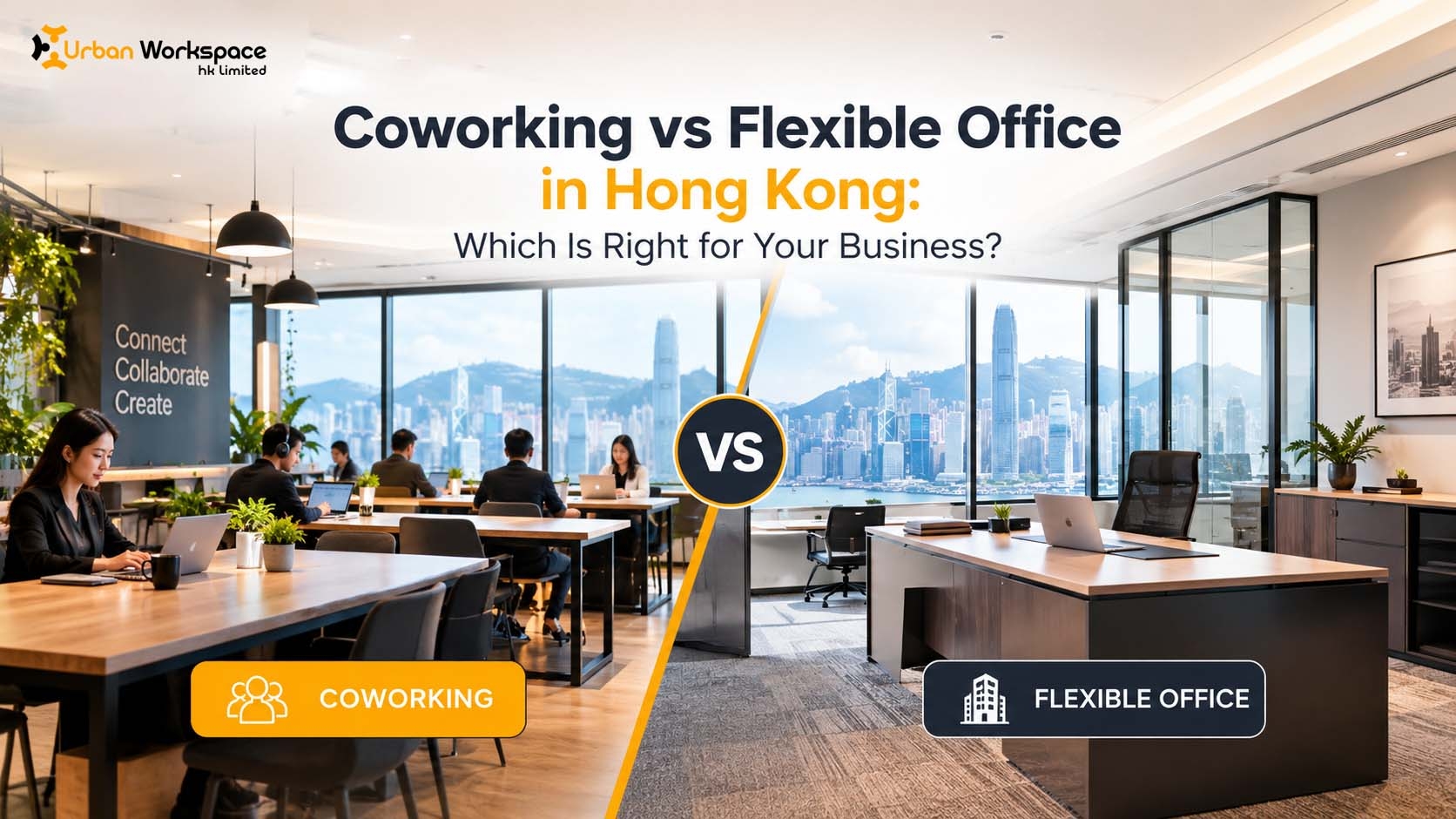
Although the terms are sometimes used interchangeably, coworking and flexible office arrangements are not exactly the same. Coworking generally focuses on shared work environments, community and accessible memberships. A flexible office usually provides a more dedicated and business-oriented setup, often with private offices, controlled access, meeting rooms and workspace that can scale with a team.
The best choice depends on how your company works. A freelancer who needs a professional desk for a few days each week has different requirements from a five-person consulting firm that needs a private office, meeting space and a stable business environment. Understanding the differences can help you avoid paying for space or services you do not actually need.
The simplest distinction is shared community versus dedicated flexibility.
A coworking space typically gives members access to shared desks, hot desks, common areas and shared facilities. It is particularly useful when interaction, networking and low-commitment access are important.
A flexible office is a broader category. It can include private offices, dedicated workstations, serviced offices, team suites and hybrid arrangements. The workspace is still flexible, but the environment can provide greater privacy, control and continuity for teams.
In practice, the boundary can overlap. A modern business centre may offer both coworking memberships and private serviced offices, allowing a business to start with shared space and move into a dedicated office as its requirements develop.
Coworking space is a shared professional environment where individuals and businesses use common workspace and facilities. Depending on the provider, members may choose hot desks, dedicated desks, private studios or other membership formats.
Coworking can be particularly attractive to freelancers, consultants, remote professionals, entrepreneurs, early-stage startups and small teams that do not need a fully private office every day.
A flexible office provides a ready-to-use professional workplace while reducing the long-term commitment and operational workload associated with a conventional office lease. It may be delivered as a private serviced office, dedicated workspace, team suite or another managed configuration.
For companies that need privacy, a consistent team environment and a more established corporate setting, a flexible or serviced office can be more suitable than an open coworking membership.
| Factor | Coworking | Flexible Office |
|---|---|---|
| Privacy | Usually shared and open | Can provide private offices and dedicated areas |
| Flexibility | Very high for individuals and small teams | High, including team and office-size changes |
| Community | Strong emphasis on networking and shared environment | More focused on business continuity and dedicated teams |
| Client meetings | Usually use shared meeting rooms | Private offices and meeting facilities can provide more control |
| Best for | Freelancers, remote workers, startups and flexible users | SMEs, established teams, professional services and growing companies |
| Team identity | Shared environment | More dedicated and brandable environment |
| Scalability | Easy for changing individual memberships | Strong for growing or restructuring teams |
Privacy is one of the most important differences. If your employees regularly handle confidential documents, financial information, client discussions or sensitive business calls, a private office may be preferable.
Coworking can still work for confidential work when the provider offers phone booths, private rooms and secure meeting facilities, but businesses should evaluate the actual layout rather than assuming that every coworking space offers the same level of privacy.
Both models are more flexible than a traditional office lease, but flexibility can mean different things. Coworking is often optimized around membership access, while flexible offices can combine flexible terms with dedicated space for a team.
For companies meeting clients, investors or business partners regularly, the appearance and functionality of the workplace matter. A flexible office with a reception area, meeting rooms and a private team environment can provide a more controlled client experience.
Coworking is usually the stronger option if you actively value interaction with other professionals. Shared environments can create opportunities for networking, referrals and informal collaboration.
A growing company may need more than a desk. It may need stable workstations, private discussions, storage, meeting facilities and a consistent environment for employees. A flexible office can offer these elements while retaining more adaptability than a conventional lease.
It is tempting to compare workspace options only by monthly price, but the better question is what is included in the total cost?
A conventional office can involve rent, deposits, furniture, utilities, internet, cleaning, reception, maintenance, fit-out and other operating expenses. Coworking and flexible offices can bundle many of these requirements into a single membership or office package.
Coworking can be cost-effective when you need only occasional or individual access. A flexible office may provide better value when you need a dedicated workspace, client meetings, business support and a stable team environment.
The cheapest desk is not always the lowest-cost business solution. The right workspace is the one that provides the services, privacy and flexibility your business actually uses.
Hong Kong businesses operate in a market where space efficiency, accessibility and flexibility can be especially important. Recent industry research also points to continued demand for flexible, modular and future-ready office environments as occupiers reassess how space supports business performance. JLL reported in March 2026 that demand in Hong Kong is increasingly focused on flexible, modular and future-proof office space. citeturn0search11
Colliers' 2026 Hong Kong Occupier Survey likewise found that many occupiers are prioritising space efficiency: 67% of surveyed occupiers expected no change in their office footprint, while 35% planned to increase headcount but only 20% expected to expand office space. citeturn0search13
These trends help explain why businesses may prefer workspace that can adapt to headcount changes instead of committing immediately to a large conventional office.
A flexible workspace can reduce the operational burden of establishing an office. Instead of coordinating a fit-out, furniture, utilities and multiple vendors, a business can focus on customers, hiring and growth.
A ready-to-use office can provide a practical base while a company evaluates the market. It can also make it easier to establish a professional local presence before making a larger long-term real-estate decision.
Hybrid work can make fixed desks inefficient when employees are not in the office every day. Coworking memberships can suit distributed individuals, while flexible private offices can support teams that still need a regular physical base.
An SME may need four desks today and eight or ten later. Flexible workspace can make that transition easier than repeatedly redesigning or relocating a traditional office.
There is also a third possibility: combine both models. For example, a business might maintain a small private office for its core team while using shared coworking facilities or meeting rooms when additional capacity is required. This hybrid approach can make sense when headcount and office attendance fluctuate.
Before signing up for any workspace, evaluate the following:
Business Center in Hong Kong offers workspace solutions including serviced offices, coworking spaces, virtual offices and meeting rooms. Its coworking offering includes options such as part-time and full-time workstations, while its broader business-centre model is designed to support businesses that need professional facilities without managing every aspect of a conventional office.
Explore Coworking Spaces in Hong Kong or view the Business Center in Hong Kong to compare workspace solutions for your business.
It can be, particularly when you need only an individual desk or occasional access. However, the best-value option depends on your need for privacy, meeting rooms, dedicated desks, business services and team capacity.
Not always, but the terms overlap. A serviced office is one type of flexible workspace that typically provides a furnished, managed and ready-to-use office. Flexible office is a broader term covering several adaptable workspace formats.
Coworking is often suitable for freelancers, remote workers, consultants, entrepreneurs, startups and small teams that want professional workspace with flexible access and a shared business community.
A flexible office can be a strong fit for SMEs, professional-services firms, international companies, project teams and growing businesses that need dedicated space, privacy and flexibility.
Yes, if the workspace provider offers multiple formats. Moving from a shared desk to a private office can be useful when the team grows or privacy requirements increase.
Review location, privacy, access hours, internet, meeting rooms, support services, contract terms, deposits, additional charges and the provider's ability to accommodate future changes in team size.
There is no single workspace model that is best for every Hong Kong business. Coworking is often ideal when flexibility, community and low-commitment access are the priority. A flexible office is generally more suitable when a company needs privacy, dedicated space, professional client facilities and room to grow.
The smartest approach is to start with your operating requirements rather than the label attached to the workspace. Think about how many people actually use the office, how often they come in, whether confidential conversations are common, how frequently you meet clients and how quickly your team may change.
For businesses that want the benefits of a professional workplace without taking on the full burden of a conventional lease, Hong Kong's flexible workspace market offers several practical choices. The right solution should give your team the space it needs today while leaving enough flexibility for tomorrow.
Ready to compare workspace options? Visit Business Center in Hong Kong to explore coworking, serviced office, virtual office and meeting-room solutions.






Trusted by entrepreneurs, startups, SMEs, and international companies for Hong Kong company formation, virtual office solutions, registered business address, company secretary services, and ongoing business support.

Business Center in Hong Kong made our Hong Kong company registration process simple and stress-free. Their consultants handled everything professionally, from documentation to incorporation. The communication was excellent, and our company was established faster than expected.

We selected their Virtual Office in Hong Kong package and couldn't be happier. The prestigious business address, professional mail handling, and responsive customer support have helped us build credibility with our international clients.

Their team provided outstanding assistance with company incorporation, company secretary services, and annual compliance. Every step was transparent, professional, and completed on time. Highly recommended for overseas entrepreneurs.

We were looking for reliable business setup services in Hong Kong, and this team exceeded our expectations. Their knowledge of local regulations and quick responses made the entire process smooth and efficient.

We've been using their registered office address and company secretary services for over two years. Everything is managed professionally, allowing us to focus entirely on growing our international business.

Excellent service from start to finish. From Hong Kong business registration to ongoing compliance support, every interaction has been professional, transparent, and reliable. We confidently recommend Business Center in Hong Kong.